Rehearse tomorrow's English conversation tonight.
Before You Speak is an AI English speaking coach for Chinese speakers who work in English abroad. Two AI colleagues with real accents act out your own situation, and when it's your turn they stop and wait for you.
No card · open to people living outside mainland China, Hong Kong and Macau · the app explains in Chinese
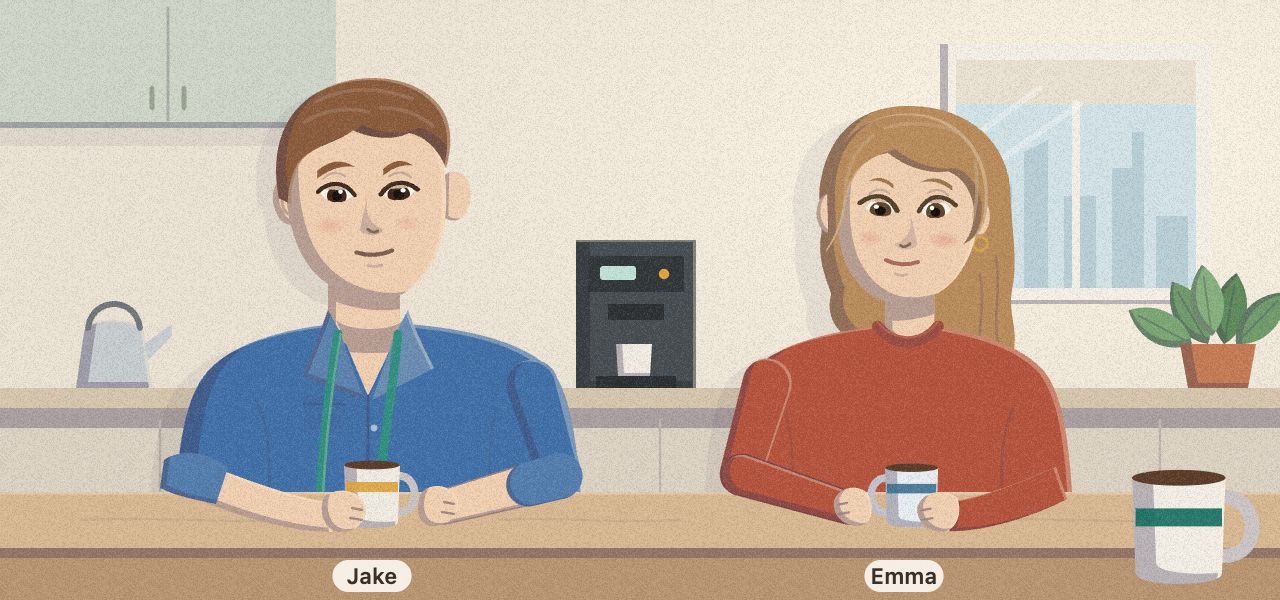
Press “Listen in”: Jake and Emma chat for about 12 seconds, then stop and turn to you. You get four turns, and after each one they carry on.
Your turn
Once you've said it, they carry on. Here they answer with a recorded next line; in the app, they answer what you actually said.
Want to rehearse your own conversation next week? Sign up free, try it for 7 days
That's the end
Want to rehearse your own conversation next week? Sign up free, try it for 7 days
The characters, dialogue and voices are AI-generated, for practice only.
How it works
What's usually missing isn't English: it's having been through that conversation once. About 15 minutes a session, in a desktop or phone browser, nothing to install. The screens and feedback below come from the app, which explains in Chinese.
-
1
Describe your situation
Write four things in Chinese: what's happening, who will be there, what you want to say, and facts only you know. In 2 to 3 minutes it becomes an English conversation you can cut into. Write “Indian colleague, talks fast” and they'll have an Indian accent and talk fast.
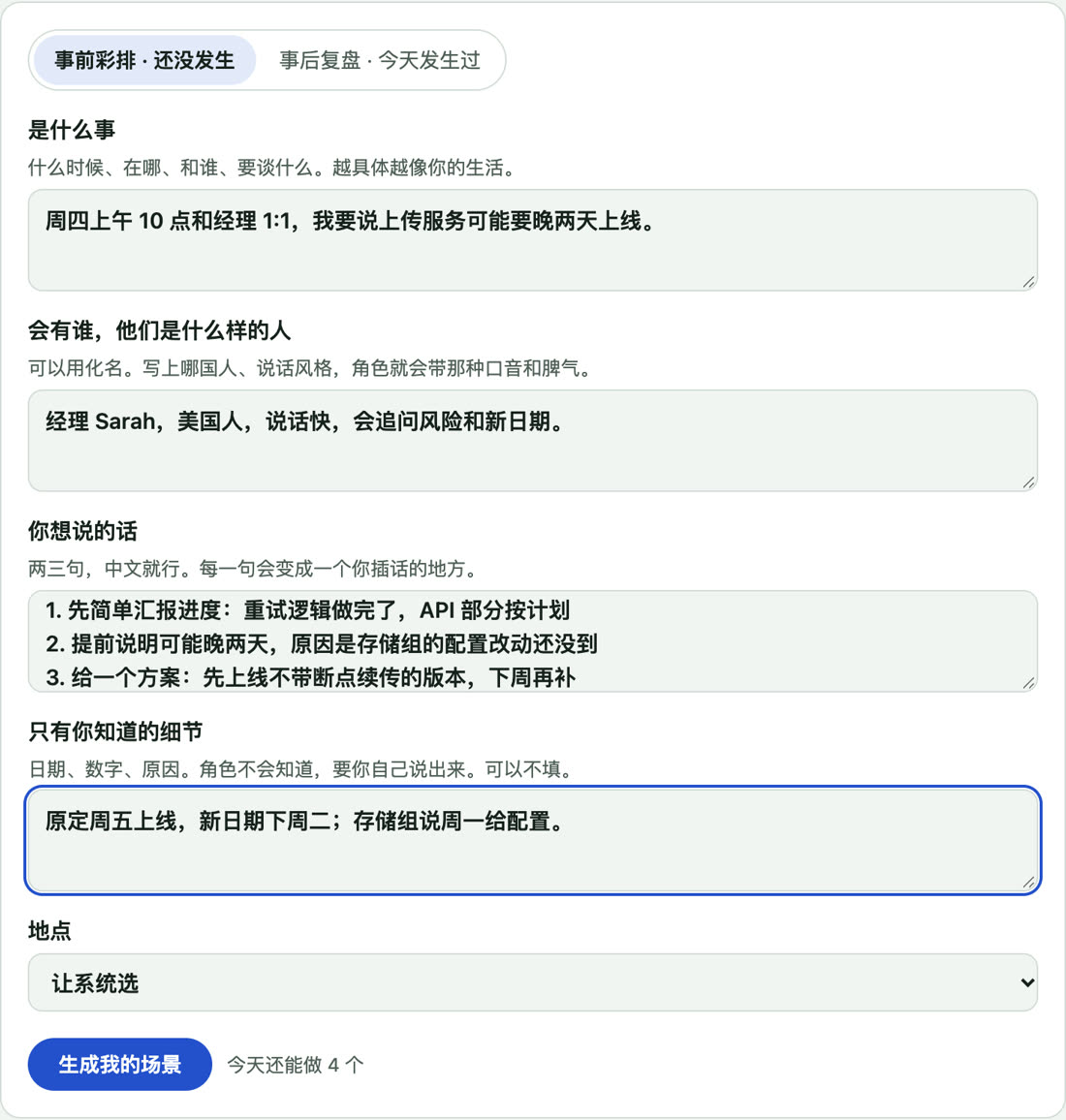
The “make my scene” form: a Thursday 1:1 with a manager -
2
Listen, then cut in
The two colleagues start talking. Subtitles are blurred at first, so you listen before you read. At your cue the scene stops and waits, with no timer. If you're stuck, hints come one tier at a time: first letters, then the English phrase, and only then the Chinese.
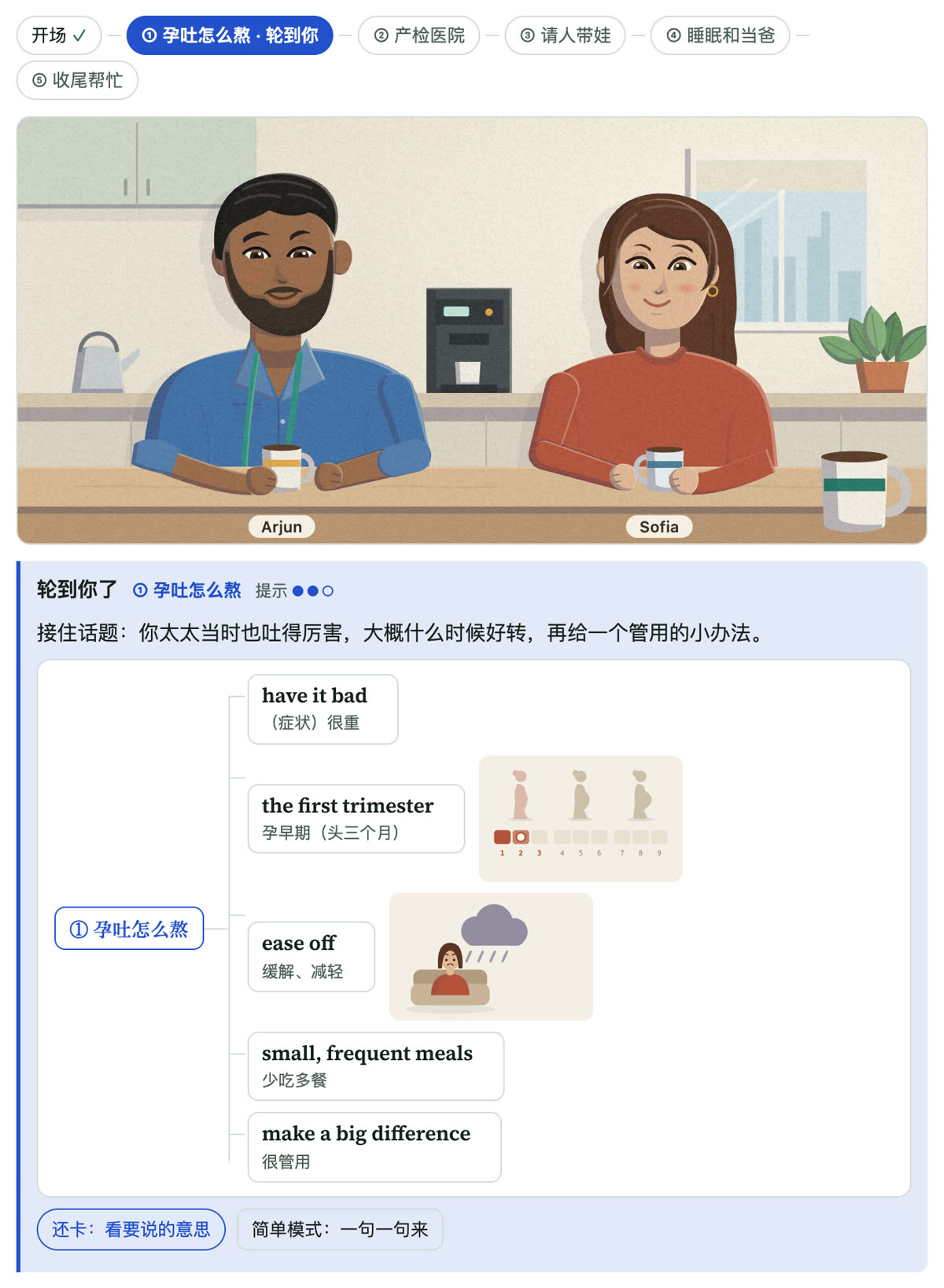
Your turn: hints at the second tier, each phrase with a picture -
3
Corrections afterwards, then review
Nobody interrupts you during the conversation. Afterwards you get at most two corrections, explained in Chinese, and they go into your review book. Next time in the scene, the colleagues look for a chance to let you use them.
点评
你主动分享了妻子的亲身经历,还给出了实用的建议,让同事 Arjun 很想继续聊下去,这是非常好的闲聊技巧。
You said:
My wife also vomit very serious in first three month, after twelve week is better.Better: My wife had really bad morning sickness in the first three months, but it got better after twelve weeks.
“vomit very serious”不自然,英语常说“bad morning sickness”(孕吐),而且讲过去的事要用过去时。
You said:
Eat little and many times is useful.Better: Small meals, little and often, really helped her.
“eat little and many times”是中文直译,英语习惯说“small meals”或“little and often”,用“really helped”比“is useful”更自然、更亲切。
Real feedback on a deliberately flawed answer, word for word (the explanations are in Chinese)
Your colleagues don't all sound American
An Irish customer at the café, an Arab mechanic at the garage, a French architect in the design review… Tap one to hear a line.
When you make your own scene, characters get an accent that fits the people you describe, from more than twenty.
Fixed once, ready to say next time
Review here isn't multiple choice: the colleague says their line again, and you answer. Rounds of 3, 8 or 15 minutes, your choice.
Pick up the thread
If you miss it, she asks “Sorry, you mean…?” and gives you the first letters; if that's not enough, she says it and you say it after her.
Phrase families
Once you know a phrase, its relatives open up: a synonym, another way to say it, an opposite, and the one that's easy to mix up. You can grow a branch of your own too.
The nausea eased off around week twelve.
The medicine wore off by the evening.
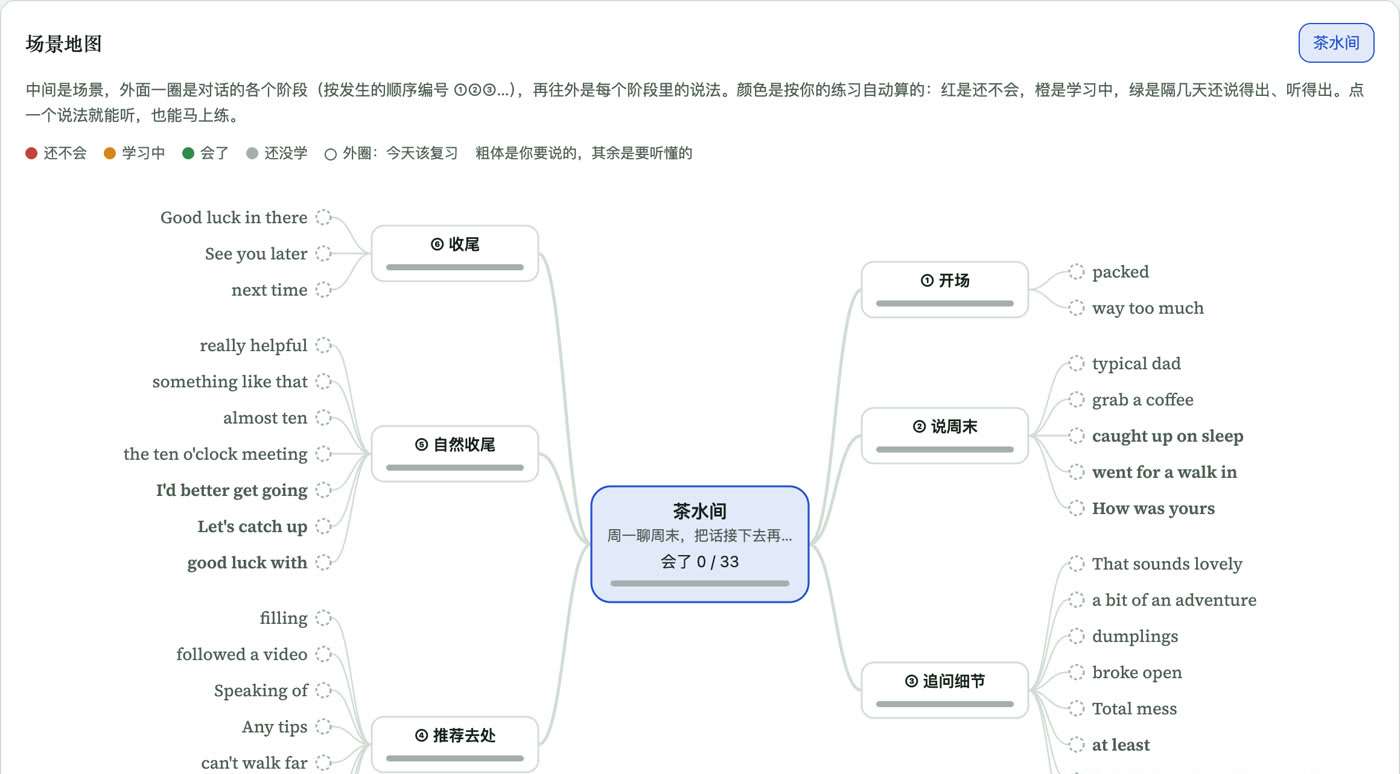
Scene map
One map per scene, with its phrases in the order of the conversation. The colours follow your practice: red is not yet, orange is learning, green is still there days later. This is a new user's map, before any practice.
Compared with general AI voice chat: 7 differences
General AI voice chat is great for talking about anything. Before You Speak does one thing: gets you ready to speak in one specific situation.
Connect your AI: it writes the scene, you do the talking
Your AI assistant already knows who you're meeting next week and what you're working on. Connect it to Before You Speak, say one sentence in the chat, and it turns that into a practice scene.
NewSay one sentence in Claude and it makes your practice scene
ChatGPT needs a Business, Enterprise, Edu or Pro plan (on Pro it can only view). Of the Chinese apps, Tencent WorkBuddy (desktop) works; Doubao desktop and QwenWork can't yet. Any other app that supports MCP: add https://app.kaikouqian.com/mcp.
Sign up first. Creating scenes and reading your progress need the free trial or a membership. You choose each permission when you connect, and can disconnect any time. The setup page is in Chinese.
Your data
Full privacy policy (Chinese) · Don't count my visits
Who makes it
I'm a Chinese engineer, and I've worked in Abu Dhabi for almost four years. One day a colleague said his wife was pregnant. My own child is two, so I'd been through all of it: the morning sickness, the checkups, finding a nanny. I had plenty to say, and what came out was a beginner's few sentences.
So I turned that office pantry into the first scene of Before You Speak and practised it myself. Now I've built it for everyone else who works in English abroad.
The maker of Before You Speak
Sign-up is open. It works in desktop and phone browsers, best in Chrome on a computer; a phone app is still in the works. Questions or ideas: write to hello@kaikouqian.com.
Questions
Who is it for?
Native Chinese speakers who work in English outside China: people who can read and write well but freeze in meetings, small talk or phone calls. Roughly intermediate to upper-intermediate (B1 to C1). The app's interface and explanations are in Chinese.
How is it different from practising with a general AI chat?
General AI chat is great for practising anything; Before You Speak focuses on the one situation you're about to face: two accented colleagues let you cut in, corrections come afterwards, and they come back in review and in later scenes.
How much does it cost?
Signing up is free and needs no card. The free plan has two live AI conversation rounds and three scripted practice sessions a week, plus the review deck. More AI practice, your own scenes and connecting your own AI come with a 7-day free trial, and nothing is charged when it ends. Memberships aren't on sale yet; the price will be stated before they are.
Can I use it in mainland China?
Not at the moment. The AI models it uses don't serve mainland China, Hong Kong or Macau, so it's open only to people living elsewhere. A version for China is being prepared: leave your email at the bottom of this page and we'll tell you when it works there.
How do I connect my AI?
Open the Connect your AI page (app.kaikouqian.com/connect, in Chinese), pick your AI and follow its steps; the address is https://app.kaikouqian.com/mcp. Claude, ChatGPT, Claude Code, Cursor, VS Code, Codex, Antigravity and Tencent WorkBuddy (desktop) can connect directly. ChatGPT needs a Business, Enterprise, Edu or Pro plan, and on Pro it can only view, not create scenes. Doubao desktop and QwenWork can't connect yet because they only accept API keys. You sign in to Before You Speak and choose the permissions, so you need an account first; searching the phrase library is open to everyone, while creating scenes and reading your progress need the free trial or a membership. For AIs that can't connect directly, such as DeepSeek or Kimi, use the persona-card prompt on the make-my-scene page.
What devices does it work on?
Chrome on a computer works best. Phone browsers work too, once you allow the microphone. There's nothing to install.
How is my email used?
The email you sign up with is for signing in and account notices; an email left on this page is only for launch news. Neither is sold to anyone or used for ads. The page records which platform a visit came from, but not your IP address, and uses no cookies. To have it deleted, write to hello@kaikouqian.com.
What does the name mean?
开口前 (kāikǒu qián) means “before you speak”: rehearse the conversation before you have it for real. The web address kaikouqian.com is the Chinese name written in pinyin.
Sign up free
The free plan has two live AI conversation rounds and three scripted practice sessions a week; your own scenes and connecting your AI come with a 7-day free trial.
No card for sign-up or the trial, and nothing is charged when it ends · open to people living outside mainland China, Hong Kong and Macau · the app is in Chinese · updated